
Managed hosting and cloud services are essential in today’s digital landscape. They offer businesses the flexibility and resources to thrive online.
In this blog post, we will explore the world of managed hosting and cloud services. These services have become crucial for many companies, providing reliable infrastructure and support. Managed hosting ensures that your servers are always up and running, while cloud services offer scalable and cost-effective solutions.
Understanding the differences and benefits of these options can help you make informed decisions for your business. Let’s dive into the key aspects of managed hosting and cloud services and see how they can support your online presence and growth.
Introduction To Managed Hosting
Managed hosting is a service where a provider takes care of the day-to-day management of servers, system hardware, and system software. This allows businesses to focus on their core activities without worrying about the technical aspects of hosting and server management. Whether you’re running a small startup or a large enterprise, managed hosting can provide you with the support needed to keep your online presence secure and efficient.
Benefits Of Managed Hosting
Managed hosting comes with numerous benefits that can significantly enhance your business operations:
- Expert Support: With managed hosting, you get access to a team of experts who handle all the technical aspects. This means fewer headaches for you and your team, allowing you to focus on your business goals.
- Enhanced Security: Providers offer robust security measures, including regular updates and monitoring, to protect your data from cyber threats.
- Scalability: Managed hosting services are designed to grow with your business. Whether you experience a sudden surge in traffic or need additional resources, scaling up is seamless.
- Performance Optimization: The service includes regular performance checks and optimization, ensuring that your website runs smoothly and efficiently.
- Cost-Effective: Managed hosting can be more cost-effective in the long run by reducing the need for in-house IT staff and infrastructure investments.
Why Businesses Choose Managed Hosting
Understanding why businesses opt for managed hosting can help you make an informed decision:
- Focus on Core Activities: By outsourcing hosting management, businesses can concentrate on what they do best—whether it’s developing products, marketing, or customer service.
- Reliability: Managed hosting providers offer high uptime and reliability, ensuring your website is always available to your customers.
- Peace of Mind: Knowing that experts are handling your hosting needs brings peace of mind. You don’t have to worry about server crashes or security breaches.
- Customized Solutions: Managed hosting allows for tailored solutions that meet the specific needs of your business. Whether you need specific software, configurations, or security measures, providers can accommodate your requirements.
- Compliance: Many businesses need to comply with industry standards and regulations. Managed hosting providers often offer compliance support to ensure your data management practices meet necessary guidelines.
Imagine having a dedicated team that handles all the intricate details of server management while you focus on growing your business. Isn’t that a relief? Managed hosting not only frees up your time but also offers peace of mind, knowing your infrastructure is in capable hands.
So, the question is, what would you do with the extra time and resources managed hosting could provide? Think about the possibilities and how it could transform your business operations.
Understanding Cloud Services
Understanding cloud services is essential for anyone interested in managed hosting and cloud solutions. These services offer flexibility, scalability, and cost efficiency. They cater to various business needs, making operations smoother and more effective.
Types Of Cloud Services
Cloud services come in different forms. The main types are public, private, and hybrid clouds. Public cloud services are available to anyone over the internet. Private cloud services are dedicated to a single organization. Hybrid cloud services combine both public and private clouds.
Key Features Of Cloud Services
Cloud services have several key features. They offer on-demand self-service, which means you can access resources as needed. They also provide broad network access. This allows access from anywhere with an internet connection.
Resource pooling is another feature. It means resources are shared among multiple users. Rapid elasticity allows you to scale resources up or down quickly. Measured service ensures you pay only for what you use.
Comparing Managed Hosting And Cloud Services
When you’re exploring web hosting options, you’ll likely come across two major contenders: managed hosting and cloud services. Both have their own unique advantages and can serve different needs. But how do you know which one is right for you? Let’s dive into the key differences and considerations to help you make an informed decision.
Differences Between Managed Hosting And Cloud Services
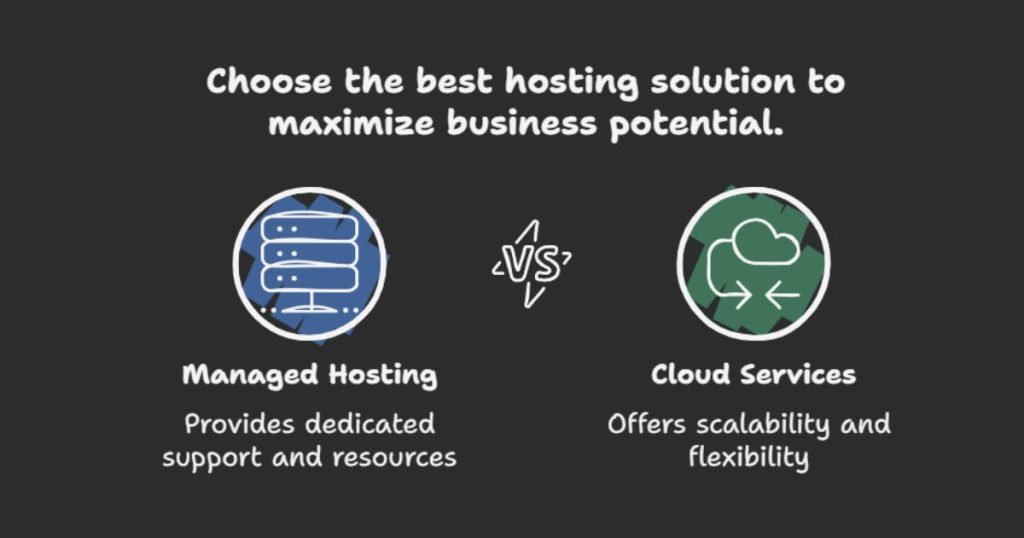
Managed Hosting: Managed hosting is like having a dedicated team that handles all the technical aspects of your website. From server setup to maintenance, security updates, and backups, you get a full-service experience. This is particularly useful if you lack the technical know-how or simply want to focus on your core business activities.
Cloud Services: On the other hand, cloud services offer scalability and flexibility. Instead of relying on a single server, your website is hosted on a network of servers. This means you can easily scale resources up or down based on your traffic needs. It’s a more versatile solution but requires a bit more technical knowledge to manage effectively.
For instance, when I first started my e-commerce site, I opted for managed hosting. It was a relief knowing that experts were handling all the backend complexities. But as my business grew, I switched to cloud services to take advantage of the scalability. This shift allowed me to handle traffic spikes during peak shopping seasons without a hitch.
Choosing The Right Solution
So, how do you decide between managed hosting and cloud services? Here are some questions to ask yourself:
- What is your technical expertise? If you’re not comfortable managing servers, managed hosting might be the way to go.
- How much traffic do you expect? Cloud services are excellent for handling fluctuating traffic, making them ideal for growing businesses.
- What’s your budget? Managed hosting can be more expensive due to the full-service nature, whereas cloud services offer more pricing flexibility.
- Do you need customization? Cloud services often provide more options for customization and integration with other tools.
Think about your specific needs and priorities. If you value hands-off management and robust support, managed hosting is a great choice. If you need flexibility and expect significant growth, cloud services could be your best bet.
Remember, there’s no one-size-fits-all answer. Your decision should align with your business goals and technical capabilities. What challenges have you faced with your current hosting solution? How do you envision your website’s future? Your answers to these questions will guide you to the best choice.
By comparing managed hosting and cloud services, you’re already a step closer to optimizing your website’s performance and scalability. Make your choice with confidence, knowing you’ve considered the essential factors.
Cost Efficiency
When considering managed hosting and cloud services, one of the biggest advantages that come to mind is cost efficiency. Imagine having the tech power you need without the hefty price tag. This isn’t a dream—it’s a reality. Managed hosting and cloud services can significantly reduce your IT expenses while providing robust performance and scalability. Let’s dive into the cost benefits of each to see why they are worth your attention.
Cost Benefits Of Managed Hosting
Managed hosting takes the burden off your shoulders by handling all the technical details for you. Here’s how it saves you money:
- No need for an in-house IT team: Managed hosting providers take care of all maintenance, security, and updates, eliminating the need for a large IT staff.
- Predictable monthly costs: With a managed hosting service, you pay a fixed monthly fee. This allows you to budget effectively without worrying about unexpected expenses.
- Reduced hardware costs: All necessary hardware is owned and maintained by the hosting provider, so you don’t have to invest in expensive servers and related equipment.
- Enhanced security: Managed hosting providers often include advanced security measures in their packages, reducing the risk of costly data breaches.
Cost Benefits Of Cloud Services
Cloud services offer another dimension of cost efficiency. Here’s how they help you save:
- Pay-as-you-go model: With cloud services, you only pay for the resources you use. This model is incredibly cost-effective, especially for growing businesses.
- Scalability: Easily scale your resources up or down based on demand. This flexibility ensures you’re not overpaying for unused capacity.
- Reduced capital expenditure: There’s no need for large upfront investments in hardware or software. The cloud provider handles all infrastructure costs.
- Lower energy costs: By using cloud services, you can reduce your energy consumption significantly, leading to lower utility bills.
Have you ever considered how much you could save by switching to managed hosting or cloud services? It’s worth taking a closer look. These solutions not only offer financial benefits but also free up your time to focus on what you do best—growing your business. Why not explore these options and see the savings for yourself?
Scalability And Flexibility
Scalability and flexibility are vital in today’s digital landscape. Businesses grow and change rapidly. Your hosting solutions must keep up. Managed hosting and cloud services offer this adaptability. They allow you to scale resources up or down based on demand. This ensures smooth operations and efficient performance.
Scalability In Managed Hosting
Managed hosting provides dedicated resources. These can be adjusted as your needs change. You get a dedicated team to manage your server. They monitor and maintain its performance. If you need more power, they can add it. This ensures your website always runs smoothly.
Another benefit is the managed aspect. Experts handle the technical side. They ensure your server performs optimally. This allows you to focus on your core business. Your hosting provider takes care of the rest. This saves you time and effort.
Scalability In Cloud Services
Cloud services offer even greater flexibility. They allow you to scale resources instantly. This is ideal for businesses with fluctuating demands. You pay for what you use. This makes it a cost-effective solution.
Cloud services also provide high availability. Your data is stored across multiple servers. This ensures uptime and reliability. If one server fails, another takes over. This guarantees your website stays online. Flexibility and scalability are the core strengths of cloud services.
Security And Compliance
Security and compliance are critical in today’s digital landscape. Businesses must protect their data and ensure they follow regulations. Managed hosting and cloud services offer robust security and compliance features. This helps businesses maintain trust and avoid legal issues.
Security Measures In Managed Hosting
Managed hosting providers prioritize security. They offer advanced firewalls to block unauthorized access. Regular security updates keep your systems safe. Managed hosting includes malware scanning to detect threats early. Providers also ensure data backups are done regularly. This protects your data from loss.
Another key feature is DDoS protection. This prevents attacks that can shut down your website. Managed hosting services also include SSL certificates. This encrypts data between the server and users. Regular audits help maintain security standards. Managed hosting ensures your data stays secure.
Security Measures In Cloud Services
Cloud services offer strong security measures. They use encryption to protect data at rest and in transit. Cloud providers have strict access controls. Only authorized users can access sensitive data. Regular security updates keep systems protected. Cloud services also include advanced threat detection. This identifies and mitigates potential security risks.
Cloud providers offer automated backups. This ensures your data is always safe. They also provide disaster recovery solutions. This helps you recover data in case of an emergency. Compliance is a priority for cloud services. They follow industry standards and regulations. This ensures your data remains secure and compliant.
Performance And Reliability
Managed hosting and cloud services ensure high performance and reliability. Systems are optimized for speed and uptime. Trustworthy solutions keep your data secure and accessible.
When it comes to choosing between managed hosting and cloud services, performance and reliability are paramount. You want your website or application to load quickly and run smoothly, without any downtime. But how do these two options stack up against each other? Let’s delve into the specifics of performance and reliability for both managed hosting and cloud services.
Performance Of Managed Hosting
Managed hosting offers dedicated resources tailored to your specific needs. This means you benefit from optimized configurations and specialized support.
Consistent Speed: With managed hosting, you typically enjoy consistent speed because the server resources are not shared. This is particularly beneficial for high-traffic websites.
Expert Maintenance: The hosting provider takes care of server maintenance and updates, ensuring that your site runs efficiently. I once had a website that struggled with slow load times. Switching to managed hosting immediately improved its performance.
Customization: You have more control over the server environment, allowing for customization to boost performance further. This can include advanced caching techniques and server-side optimizations.
Performance Of Cloud Services
Cloud services, on the other hand, offer a different kind of performance advantage. They are designed to be scalable and flexible.
Scalability: One of the most significant benefits of cloud services is their ability to scale resources up or down based on demand. If you expect a sudden spike in traffic, the cloud can handle it without a hitch.
Global Reach: Cloud services often come with a global network of data centers. This means your content can be delivered from a location closest to your user, reducing latency and improving load times.
Resource Efficiency: Cloud providers use advanced algorithms to optimize resource allocation, ensuring that you only pay for what you use. This can lead to cost savings while maintaining high performance.
Reliability Of Managed Hosting
Reliability in managed hosting is typically very high due to dedicated support and robust infrastructure.
Dedicated Support: Managed hosting providers offer round-the-clock support. If an issue arises, you have experts ready to resolve it quickly.
Proactive Monitoring: Managed hosts often include proactive monitoring services. They can detect and fix issues before they impact your site’s reliability.
Redundancy: Many managed hosting providers offer redundant systems and backups. This means your data is safe, and your site remains operational even in the event of a hardware failure.
Reliability Of Cloud Services
Cloud services are also highly reliable, but they achieve this in different ways.
High Availability: Cloud services are designed for high availability. They use distributed resources to ensure that even if one server fails, your site remains up and running.
Automatic Failover: In the cloud, your data is replicated across multiple servers. If one server goes down, the system automatically switches to another, minimizing downtime.
Disaster Recovery: Many cloud providers offer comprehensive disaster recovery options. This means your data can be restored quickly in the event of a catastrophic failure.
Choosing between managed hosting and cloud services depends on your specific needs. Both offer excellent performance and reliability, but they do so in different ways. What’s more important to you: the dedicated resources and specialized support of managed hosting, or the scalability and global reach of cloud services?
The choice is yours, but understanding these nuances can help you make an informed decision.
Case Studies
When considering managed hosting and cloud services, real-life examples can offer invaluable insights. Case studies highlight the practical applications and benefits of these solutions. They showcase how businesses have successfully implemented managed hosting and cloud services to achieve their goals. Let’s delve into some compelling case studies to understand the transformative power of these technologies.
Successful Managed Hosting Implementations
One notable example comes from a mid-sized e-commerce company. They were facing frequent downtime and slow loading times, which were driving customers away. After switching to managed hosting, their website’s performance improved significantly. Uptime increased to 99.9%, and page load times were cut in half. This led to a 30% increase in sales within three months.
Another interesting case involves a healthcare provider struggling with data security and compliance. Managed hosting offered them a solution that not only ensured HIPAA compliance but also enhanced data encryption and backup processes. This resulted in fewer security breaches and a more reliable service for patients.
You might be wondering if managed hosting is right for your business. Consider your current challenges. Are you dealing with slow website performance or security issues? Managed hosting could be the answer.
Successful Cloud Service Implementations
A tech startup needed to scale quickly without investing heavily in physical infrastructure. They turned to cloud services, which allowed them to scale up resources on demand. This flexibility enabled them to launch new features faster and handle traffic spikes effortlessly. Their user base doubled within six months, thanks to the agility provided by cloud services.
In another case, a financial services firm used cloud services to improve their data analytics capabilities. By leveraging cloud-based tools, they could process large datasets more efficiently and gain insights faster. This improved their decision-making process and gave them a competitive edge in the market.
Think about your business goals. Do you need to scale quickly or enhance your data analytics? Cloud services might be the solution you’ve been looking for.
Case studies are more than just success stories. They offer practical, actionable insights that can help you make informed decisions about your own hosting and cloud service needs. What challenges are you facing, and how can managed hosting and cloud services help you overcome them?
Future Trends
The future of managed hosting and cloud services is an exciting space to watch. With technology evolving at breakneck speed, these services are poised to transform how businesses operate. Let’s dive into the innovations that are shaping the future.
Innovations In Managed Hosting
Managed hosting is no longer just about providing server space. It’s about creating a seamless, secure, and highly efficient environment for your digital assets.
- AI and Machine Learning: AI and machine learning are being integrated into managed hosting solutions to predict and prevent issues before they happen. Imagine your server automatically optimizing resources based on traffic patterns.
- Enhanced Security Measures: With cyber threats on the rise, managed hosting providers are investing heavily in advanced security protocols. Expect to see more AI-driven security features that can detect and mitigate threats in real-time.
- Scalability on Demand: Businesses need flexibility. Future managed hosting services will offer even greater scalability, allowing you to scale up or down seamlessly as your needs change.
Innovations In Cloud Services
Cloud services are the backbone of modern business operations, and innovation in this space is relentless.
- Edge Computing: Edge computing is pushing data processing closer to the source of data. This reduces latency and improves performance. Think about how this could revolutionize real-time data analytics and IoT applications.
- Serverless Architectures: Serverless computing is gaining traction because it abstracts server management, allowing developers to focus solely on code. This means faster deployment times and reduced operational overhead.
- Multi-Cloud Strategies: More businesses are adopting multi-cloud strategies to avoid vendor lock-in and optimize performance. Cloud services are becoming more interoperable, making it easier to integrate and manage multiple cloud environments.
As you look ahead, consider how these trends might impact your business. Are you prepared to leverage AI in your managed hosting strategy? What about adopting edge computing or a multi-cloud approach?
Staying ahead of these trends will not only keep you competitive but also ensure that your digital infrastructure is robust and future-proof. The key is to stay informed and be ready to adapt.
What steps are you taking to prepare for these future trends in managed hosting and cloud services? Share your thoughts in the comments below!
Frequently Asked Questions
What Is The Difference Between Cloud And Managed Hosting?
Cloud hosting uses multiple servers to host websites, ensuring scalability and redundancy. Managed hosting offers dedicated support and maintenance for your server, enhancing performance and security.
What Is Managed Cloud Hosting?
Managed cloud hosting is a service where a third-party provider handles server management. They maintain, monitor, and support cloud infrastructure. This allows businesses to focus on growth. Managed hosting includes security, backups, updates, and scalability.
What Is A Managed Hosting Service?
A managed hosting service provides server management, maintenance, and support by the hosting provider. This allows businesses to focus on their core activities.
What Is The Difference Between Hosting Services And Cloud Services?
Hosting services provide dedicated servers for websites. Cloud services offer scalable, on-demand resources across multiple servers. Hosting is fixed, while cloud adapts to needs.
Conclusion
Managed hosting and cloud services simplify tech management. These solutions save time and reduce stress. Businesses gain flexibility, scalability, and security. No need to manage servers or updates. Focus shifts to core activities, driving growth. Reliable support ensures smooth operations.
Managed hosting and cloud services fit various business needs. Embrace these services to enhance efficiency. Explore options and choose what’s best. Enjoy peace of mind with expert management.