
Cloud and hosted services both offer ways to manage data and applications online. They sound similar, but there are key differences.
Cloud services provide resources over the internet, allowing you to access data from anywhere. Hosted services, on the other hand, involve renting space on a server owned by a provider. Understanding these differences can help you choose the right solution for your needs.
In this post, we will explore the main distinctions between cloud and hosted services. This will help you make an informed decision for your business or personal use. Let’s dive into the details and see which option suits you best.
Introduction To Cloud And Hosted Services
In today’s digital world, businesses often rely on technology to run smoothly. Two popular options are cloud services and hosted services. Both offer unique benefits. But what exactly are they? Let’s dive into an introduction to cloud and hosted services.
Defining Cloud Services
Cloud services allow businesses to use computing resources over the internet. These resources include storage, servers, databases, and software. The key feature is that users can access these services from anywhere. The provider manages and maintains the infrastructure. This means businesses do not need to worry about hardware upkeep. Examples include Google Drive and Microsoft Azure.
Defining Hosted Services
Hosted services involve a third party hosting applications or websites on their servers. These services are typically accessed via the internet. The hosting provider takes care of server management. This includes hardware, software, and security updates. Users benefit from dedicated resources and better control. Examples include shared hosting and dedicated hosting plans.
Key Characteristics
Understanding the key characteristics of cloud and hosted services helps businesses choose the right solution. Both have unique features that cater to different needs. Below, we explore the main aspects of scalability and accessibility.
Scalability
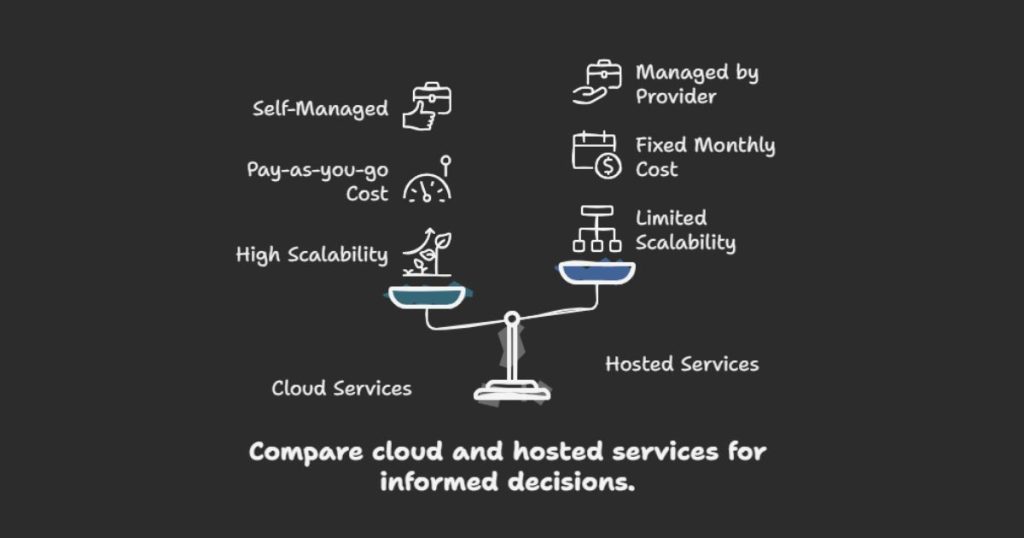
Scalability is a major factor in choosing between cloud and hosted services. Cloud services offer dynamic scalability. Resources can be adjusted quickly to meet demand. This flexibility allows businesses to grow without worrying about infrastructure limits.
Hosted services, on the other hand, have fixed scalability. Upgrading requires manual intervention and often additional costs. Businesses may face limitations if demand exceeds capacity. Planning for future needs is crucial with hosted services.
Accessibility
Accessibility is another key characteristic. Cloud services provide access from anywhere with an internet connection. This remote access enhances productivity and collaboration. Teams can work together regardless of location.
Hosted services typically have limited accessibility. Access is often tied to specific locations or devices. This can restrict flexibility and mobility for businesses. Ensuring secure and reliable access is a challenge with hosted solutions.
Infrastructure Differences
When deciding between cloud and hosted services, understanding the infrastructure differences is crucial. These differences can significantly impact your business operations, scalability, and cost-efficiency. Let’s dive into the specifics to help you make an informed decision.
Cloud Infrastructure
Cloud infrastructure is like renting an apartment in a large complex. You share resources with other tenants but have your own private space. This setup offers flexibility and scalability.
You can easily scale up your resources as your business grows. For example, adding more storage or computing power is just a few clicks away. This is particularly useful for businesses with fluctuating demands.
Another advantage is the pay-as-you-go model. You only pay for what you use, which can be cost-effective. Imagine needing extra computing power for a big project. With cloud infrastructure, you can get it instantly and then scale back down when you’re done.
Hosted Infrastructure
Hosted infrastructure, on the other hand, is like owning a house. You have dedicated resources, and you don’t share them with anyone else. This means more control and often better performance.
With hosted services, you usually have a fixed cost. This can be beneficial for budgeting. However, scalability can be an issue. If you need more resources, it often means upgrading your entire setup.
Security is another consideration. Hosted infrastructure can offer more robust security measures since you’re not sharing resources. This can be crucial for businesses handling sensitive data.
So, what’s more important for your business—flexibility and cost-efficiency or control and security? Think about your specific needs and choose the infrastructure that best aligns with your goals.
Deployment Models
Choosing the right deployment model for your business can be challenging. Whether you opt for cloud services or hosted services, understanding the differences between these models is crucial. Let’s break down the main types: Public Cloud, Private Cloud, and Hosted Models.
Public Cloud
Public cloud services are like renting space in a massive, shared building. You get access to resources like servers and storage, but you share them with other tenants. Think of services like Amazon Web Services (AWS) or Microsoft Azure.
These services are scalable and cost-effective. You pay for what you use, making it easy to manage your expenses. However, sharing resources can sometimes lead to performance issues during peak times.
Public clouds are ideal for startups or small businesses. They offer flexibility and allow you to grow without significant upfront investments. Do you want to save costs and scale quickly? Public cloud might be your answer.
Private Cloud
Private cloud services are like owning your own building. You have dedicated resources that are exclusively for your use. This setup provides higher security and better performance.
Private clouds can be hosted on-premises or by third-party providers. They offer more control and customization options. You’ll find them useful if you have stringent compliance requirements or need guaranteed performance.
While private clouds can be more expensive, they offer peace of mind. Your data stays secure, and you won’t face resource competition. Do you need control and security? Consider a private cloud.
Hosted Models
Hosted models are a middle ground. You rent dedicated resources from a provider, but you don’t share them with others. This is like leasing an entire floor in a building just for your company.
These services offer more customization and control than public clouds. They are managed by the provider, freeing you from maintenance tasks. Hosted models are great for businesses that need dedicated resources without the hassle of managing them.
Hosted services can be more expensive than public clouds but less costly than private clouds. Do you need a blend of control and convenience? Hosted models might be the perfect fit.
Choosing the right deployment model depends on your business needs. Are you looking for cost savings, security, or control? Each model offers unique advantages. How do you see your business evolving with these options?
Cost Implications
Cloud services often have flexible pricing models, while hosted services typically involve fixed costs. Businesses may prefer cloud services for scalability.
When deciding between cloud and hosted services, understanding the cost implications is crucial. It’s not just about the initial investment but also the ongoing expenses. Let’s break this down into initial costs and maintenance costs.
Choosing cloud services usually means lower initial costs. Most cloud providers operate on a pay-as-you-go model. This means you pay for what you use, which can be more affordable upfront.
Hosted services, on the other hand, often require a significant initial investment. You might need to purchase hardware and software licenses. This can be a big expense, especially for small businesses.
Consider your budget and how much you can afford to spend initially. Cloud services might be more appealing if you have limited funds.
Maintenance costs for cloud services can be more predictable. Providers handle the updates and maintenance. This means fewer surprises for you.
With hosted services, you’re responsible for maintaining the hardware and software. This can be time-consuming and expensive. You may need to hire IT staff or consultants.
Think about your team’s skills and capacity. Can they handle the maintenance, or would it be better to outsource it?
In the long run, cloud services might save you money. But hosted services can offer more control. Weigh these factors carefully to make the best decision for your needs.
Have you considered all the hidden costs? What might save you money now could cost more later.
Security Aspects
Security is a primary concern for businesses deciding between cloud and hosted services. Both offer unique advantages and challenges. Understanding their security aspects helps in making an informed decision.
Cloud Security
Cloud services often provide robust security measures. They employ advanced encryption to protect data. Many cloud providers also offer multi-factor authentication. This adds an extra layer of security.
Cloud services regularly update their security protocols. They have dedicated teams to monitor and prevent security breaches. This reduces the risk of unauthorized access.
Data in the cloud is usually backed up across multiple locations. This ensures data recovery in case of a disaster. Cloud services also comply with international security standards.
Hosted Security
Hosted services often rely on physical servers. These servers are usually located in a specific data center. Security measures for hosted services include firewalls and regular updates.
Hosted services may have limited encryption options. This can pose a risk if not properly managed. Regular monitoring and maintenance are essential to ensure security.
Data recovery in hosted services depends on backup policies. It’s crucial to have a reliable backup system in place. Compliance with security standards varies among hosting providers.
Performance And Reliability
Performance and reliability are crucial factors in choosing between cloud and hosted services. Understanding how each impacts your business can help you make an informed decision. Let’s dive into the key aspects of performance and reliability.
Performance Metrics
Cloud services often provide scalable resources. This means they can handle variable loads effectively. Performance is usually consistent. Cloud providers use global data centers to reduce latency. This results in faster access times.
Hosted services, on the other hand, depend on the physical server’s capacity. Performance can degrade if the server is overloaded. Upgrades may require downtime, impacting overall performance.
Reliability Factors
Cloud services offer high reliability. They use redundant systems to ensure uptime. Failover mechanisms are in place to handle issues. Data is often backed up across multiple locations.
Hosted services may not offer the same level of redundancy. They are more prone to single points of failure. If the server goes down, your service could be offline. Regular maintenance is crucial to ensure reliability.
Use Cases And Applications
Understanding the difference between cloud and hosted services can be pivotal for businesses aiming to optimize their IT infrastructure. Let’s dive into the use cases and applications for both, helping you decide which might be the best fit for your needs.
Ideal Scenarios For Cloud
Cloud services shine in situations where scalability and flexibility are crucial. Imagine you’re running an online store. During holiday seasons, traffic spikes. Cloud services allow you to scale up resources quickly to handle the surge, then scale down once traffic normalizes, saving costs.
Another scenario is when your team works remotely. Cloud services provide easy access to applications and data from anywhere. This ensures seamless collaboration and increased productivity.
Startups and small businesses often benefit from cloud services because they can avoid hefty upfront investments in hardware. Instead, they pay for what they use, which is easier on tight budgets.
Ideal Scenarios For Hosted
Hosted services are perfect for businesses with specific compliance needs. If you’re in a regulated industry like healthcare or finance, hosted services can provide the necessary control over data and infrastructure to meet strict regulations.
Consider a business that requires custom configurations or specialized hardware. Hosted services allow you to tailor the environment to your exact specifications, ensuring optimal performance for your applications.
If your company has predictable workloads and prefers a more stable, long-term cost structure, hosted services might be the better choice. You gain dedicated resources without the variable pricing associated with cloud services.
Ultimately, the choice between cloud and hosted services depends on your specific needs and goals. By understanding the ideal scenarios for each, you can make a more informed decision. What are your primary considerations when choosing between these services?
Future Trends
The digital landscape is evolving rapidly. Understanding future trends in cloud and hosted services is essential. These trends will shape how businesses operate. They will also influence user experiences and technological advancements. Staying informed helps you make better decisions for your business.
Emerging Technologies
Emerging technologies are transforming cloud and hosted services. Artificial intelligence (AI) and machine learning (ML) are leading the charge. These technologies enhance data processing and security. They also help in automating routine tasks.
Edge computing is another significant trend. It brings computation and data storage closer to the user. This reduces latency and improves performance. Quantum computing is also on the horizon. It promises to solve complex problems faster than traditional computers.
Industry Predictions
Experts predict a continued rise in cloud adoption. Businesses will prefer cloud services for their flexibility and cost-effectiveness. Hosted services will also see growth. They offer specific solutions tailored to business needs.
Hybrid cloud models will become more popular. They combine the best of both public and private clouds. This ensures better data control and scalability. The focus on cybersecurity will intensify. Both cloud and hosted services will invest in advanced security measures.
The integration of Internet of Things (IoT) with cloud services will expand. This will create new opportunities for data collection and analysis. Blockchain technology will also play a role. It will enhance security and transparency in data transactions.
Frequently Asked Questions
How Is A Cloud Different From Hosted It Services?
Cloud services offer scalable, on-demand resources via the internet. Hosted IT services provide fixed resources managed by a third party.
Is Hosting The Same As Cloud?
No, hosting and cloud are not the same. Hosting refers to storing websites on a server. Cloud involves a network of servers for storage and computing.
What Is A Hosted Service?
A hosted service is a solution where a provider manages and delivers software or infrastructure via the internet. It allows businesses to access applications and resources without maintaining hardware. Hosted services improve scalability, reduce costs, and enhance security. Examples include web hosting, cloud storage, and SaaS platforms.
What Is The Difference Between Cloud And Managed Hosting?
Cloud hosting uses multiple servers to balance load and maximize uptime. Managed hosting offers dedicated support and maintenance services.
Conclusion
Choosing between cloud and hosted services depends on your needs. Cloud services offer flexibility and scalability. Hosted services provide control and customization. Both options have unique benefits. Cloud services suit businesses that need fast adaptation. Hosted services fit those wanting tailored solutions.
Cost, security, and performance play vital roles. Consider your company’s size and goals. Analyze the resources you need. Think about future growth. Make an informed decision. Understanding differences helps you choose wisely. Select the service that aligns with your strategy.
Your choice impacts efficiency and success.