
Augmented Reality (AR) is changing how businesses operate. It blends digital elements with the real world.
AR technology offers unique opportunities for businesses. Imagine customers trying products virtually before buying. Or employees receiving real-time, hands-on training through AR. This technology is no longer just for gaming or entertainment. It’s transforming retail, healthcare, manufacturing, and more. Companies can engage customers in new ways, improve efficiency, and reduce costs.
AR provides interactive and immersive experiences, setting businesses apart from competitors. In this blog, we will explore how AR is used in various industries. We’ll look at its benefits and potential challenges. So, let’s dive into the world of Augmented Reality in business and discover its impact.
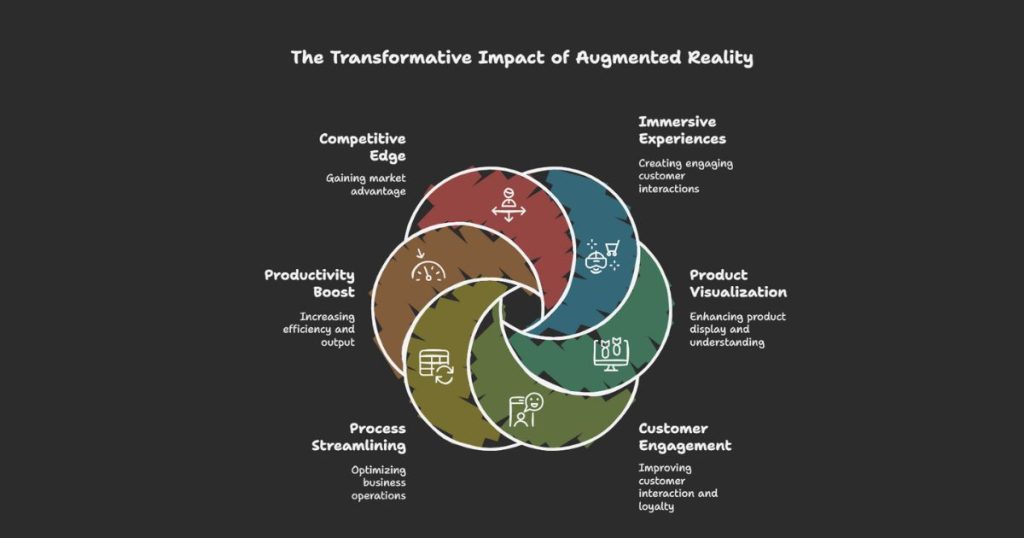
Introduction To Augmented Reality
Augmented Reality (AR) is transforming the business landscape by blending the digital and physical worlds. This exciting technology brings new opportunities for companies to engage with customers, enhance productivity, and streamline operations. In this blog post, we will delve into the fascinating realm of Augmented Reality, starting with an introduction to its core concepts and historical background.
What Is Augmented Reality?
Augmented Reality (AR) overlays digital information onto the real world using devices like smartphones, tablets, or AR glasses. Imagine walking down a street and seeing restaurant reviews pop up as you look at each establishment. Or picture assembling furniture with step-by-step instructions projected onto the parts. That’s AR in action—augmenting your experience with useful digital content.
Unlike Virtual Reality (VR), which immerses you in a completely virtual environment, AR enhances your real-world surroundings. This makes AR particularly valuable for businesses, as it can improve customer interactions, training programs, and product visualizations without detaching users from their physical environment.
Brief History Of AR
The journey of AR began decades ago. In 1968, computer scientist Ivan Sutherland created the first head-mounted display system, which laid the groundwork for AR technology. However, it was bulky and impractical for everyday use.
Fast forward to the early 1990s, when Boeing used AR to assist in aircraft manufacturing. The technology allowed workers to see wiring instructions overlaid on physical components, significantly reducing errors and improving efficiency.
In 2009, the launch of ARToolkit, an open-source library, enabled developers to create AR applications more easily. This was a game-changer, as it democratized AR development and led to a surge in innovative applications across various industries.
One of the most notable AR breakthroughs came in 2016 with the release of Pokémon GO. This mobile game captured the world’s attention by allowing players to catch virtual creatures in real-world locations. It showcased AR’s potential for creating engaging and interactive experiences.
Today, AR technology is more accessible and advanced than ever. With the advent of powerful smartphones and wearable devices, businesses of all sizes can leverage AR to enhance their operations and customer interactions.
So, how can your business benefit from AR? What innovative applications can you explore to stay ahead of the curve? Stay tuned as we dive deeper into the practical applications and benefits of AR in the next sections of this blog post.
AR In Retail
Augmented Reality (AR) is transforming the retail industry. It offers immersive experiences that enhance customer engagement and satisfaction. AR in retail provides a unique way to interact with products, making shopping more interactive and personalized.
Enhanced Shopping Experience
AR creates an engaging shopping experience. Customers can visualize products in their environment. This helps them make better purchasing decisions. Stores can display detailed product information using AR. It simplifies understanding features and benefits.
AR can also guide customers in-store. It offers directions and highlights promotions. This makes shopping easier and more enjoyable.
Virtual Try-ons
Virtual try-ons are one of the most popular AR applications in retail. Customers can try on clothes, accessories, and even makeup virtually. This eliminates the need for physical fitting rooms. It saves time and reduces the hassle of trying multiple items.
Shoppers can see how products look on them in real-time. They get a realistic idea of fit and style. This increases confidence in their purchase decisions. It also reduces the rate of returns.
Virtual try-ons offer convenience. Customers can try products from the comfort of their homes. This enhances the online shopping experience significantly.
AR In Manufacturing
Augmented Reality (AR) is transforming the manufacturing industry. It offers innovative solutions that enhance production, maintenance, and training. AR technology enables manufacturers to improve efficiency and reduce errors. Let’s explore how AR is making a difference in manufacturing.
Streamlining Production Processes
AR helps streamline production processes. Workers can visualize complex assemblies with AR displays. This reduces the need for physical prototypes. AR devices provide real-time instructions and guidance. This minimizes mistakes and speeds up production.
AR overlays digital information onto physical objects. This assists workers in understanding intricate components. It also facilitates easier quality control. By using AR, manufacturers can maintain high standards and consistency. Overall, AR enhances productivity and accuracy in production.
Maintenance And Training
AR simplifies maintenance tasks. Technicians can see step-by-step repair instructions. This reduces downtime and increases efficiency. AR also helps in identifying potential issues before they become serious problems. This proactive approach prevents costly breakdowns.
Training becomes more effective with AR. New employees can learn faster with interactive AR modules. They can practice procedures in a safe, virtual environment. This builds confidence and competence. Using AR for training ensures that workers are well-prepared for real-world tasks.
In summary, AR in manufacturing offers significant advantages. It streamlines production processes and enhances maintenance and training. By adopting AR, manufacturers can achieve better efficiency and quality.
AR In Healthcare
Augmented Reality in business enhances healthcare by providing advanced tools for medical training and patient care. Doctors can visualize complex procedures, improving accuracy and outcomes.
Augmented Reality (AR) is transforming various industries, and healthcare is no exception. Imagine a world where your doctor can see inside your body without making a single incision or where medical students can practice surgeries in a risk-free environment. This is the promise of AR in healthcare.
Medical Training And Simulation
AR is revolutionizing medical education. It allows students to interact with 3D models of the human body. You can rotate, zoom, and explore these models from every angle. This provides a deeper understanding of human anatomy than textbooks ever could.
Consider the impact of performing virtual surgeries. Aspiring surgeons can practice complex procedures multiple times, refining their skills without any risk to real patients. This hands-on experience builds confidence and competence. It’s like having a flight simulator for pilots but for doctors.
Patient Care And Surgery Assistance
AR is also enhancing patient care. Imagine you’re undergoing surgery, and your surgeon can see critical information superimposed onto your body in real-time. This could include vital signs, previous scans, and even the location of crucial blood vessels.
Such technology minimizes risks and increases precision. For instance, AR can guide surgeons through minimally invasive procedures, reducing recovery times and improving outcomes.
But it’s not just about surgeries. AR can assist in everyday patient care too. Think about physiotherapy sessions where patients follow AR-guided exercises at home, ensuring they perform movements correctly. This can speed up recovery and improve overall health outcomes.
Are you ready to embrace this new era of healthcare?
AR In Real Estate
Augmented Reality (AR) is transforming the real estate industry. It offers innovative ways to interact with properties. From virtual tours to architectural visualization, AR is changing how we buy, sell, and design homes.
Virtual Property Tours
With AR, potential buyers can take virtual tours of properties. They can explore homes from any location. This saves time and effort. AR tours provide a realistic feel of the property. Buyers can see every room in detail. They can even visualize how their furniture will fit.
Architectural Visualization
AR helps in architectural visualization. Architects can create 3D models of buildings. Clients can see these models in real-world settings. This makes it easy to understand design concepts. Changes can be made quickly and viewed in real-time.
AR In Marketing
Augmented Reality (AR) has transformed various business sectors. One significant area is marketing. AR in marketing offers immersive and interactive experiences. It bridges the gap between digital and physical worlds. Businesses can use AR to engage customers in new ways.
Interactive Advertising
Interactive advertising through AR creates memorable experiences. Customers can see products in their real environment. This helps them make better purchase decisions. For example, furniture companies use AR to show how items look in homes. Clothing brands allow customers to try on clothes virtually. These experiences drive higher engagement and conversions.
Customer Engagement
AR boosts customer engagement by making interactions fun. Customers can play games related to the brand. They can unlock special features or content. This keeps them interested and involved. AR also helps in educating customers about products. They can see detailed information and benefits. This improves their understanding and trust in the brand.
AR In Education
Augmented Reality (AR) is transforming many industries. One significant area is education. AR in education offers dynamic and interactive learning experiences. It helps engage students and enhance their understanding.
Immersive Learning Experiences
AR provides students with immersive learning experiences. It brings abstract concepts to life. For example, students can explore the human body in 3D. They can see and interact with organs, bones, and muscles. This makes learning more engaging and memorable.
AR can also take students on virtual field trips. They can visit historical sites or explore the ocean. All without leaving the classroom. This hands-on approach helps students retain information better.
Collaborative Learning
AR also promotes collaborative learning. Students can work together on AR projects. They can solve problems and share ideas in real time. This fosters teamwork and communication skills.
Moreover, AR tools can be used in group activities. For instance, a class can build a virtual model of a city. Each student can contribute different elements. This collaborative effort makes learning more interactive and fun.
Challenges And Future Of AR
Augmented Reality (AR) is transforming how businesses operate, from enhancing customer experiences to streamlining internal processes. However, like any emerging technology, AR faces its share of challenges. Understanding these obstacles and the potential innovations on the horizon is crucial for businesses looking to leverage AR effectively.
Technical Limitations
One of the primary hurdles AR faces is the technical limitations inherent in the technology. Current AR applications often require high-performance hardware, which can be expensive and inaccessible for many businesses. Additionally, the precision of AR is sometimes lacking, which can lead to a less-than-perfect user experience.
Imagine trying to demonstrate a new product to a client using an AR app, only to have the app lag or the product appear misaligned. This can be frustrating and may even deter potential customers. Therefore, ensuring your hardware can support AR applications is a critical step.
Another technical challenge is the lack of standardized AR development platforms. This can make it difficult for developers to create consistent and reliable AR experiences across different devices. As businesses, you need to be aware of these limitations and plan for potential discrepancies in user experience.
Potential Innovations
The future of AR in business is bright, with numerous innovations on the horizon that promise to address current technical limitations. One exciting development is the improvement of AR glasses and headsets. These devices are becoming more affordable and user-friendly, which will make AR more accessible for businesses of all sizes.
Another area of innovation is in software development. Companies are working on more sophisticated AR platforms that offer better accuracy and stability. This means you can expect more reliable and immersive AR experiences in the near future.
Moreover, advances in AI and machine learning are set to revolutionize AR. Imagine an AR app that not only overlays digital information but also learns from user interactions to offer personalized recommendations and insights. This could drastically enhance customer experiences and drive engagement.
However, the question remains: Are you prepared to integrate these innovations into your business strategy? Staying ahead of the curve requires continuous learning and adaptation. Consider investing in AR training for your team or partnering with AR specialists to get the most out of this technology.
In conclusion, while AR in business faces significant challenges, the potential for innovation makes it an exciting space to watch. By understanding the technical limitations and preparing for future advancements, you can position your business to reap the benefits of AR technology.
Frequently Asked Questions
How Is Augmented Reality Used In Businesses?
Augmented reality enhances customer experiences, visualizes products, and aids training. It improves marketing, streamlines operations, and boosts sales with immersive, interactive technology.
How Does Coca Cola Use Augmented Reality?
Coca Cola uses augmented reality for interactive marketing campaigns. Customers scan QR codes to access engaging AR experiences. This technology boosts brand engagement and enhances customer interaction.
What Is An Example Of How Ar Is Used In A Business Setting?
AR is used in retail to create virtual fitting rooms. Customers can try on clothes using AR mirrors, enhancing their shopping experience.
What Are The Potential Applications Of Augmented Reality In Business?
Augmented reality can enhance product visualization, improve customer experiences, streamline training, and boost marketing campaigns in business. It also aids in remote collaboration and inventory management.
Conclusion
Augmented reality brings new possibilities to businesses. It enhances customer experiences. Employees can train more effectively. Product presentations become more engaging. This technology also helps with remote assistance. Costs can be reduced, and efficiency improved. Industries across the board are adopting AR.
It’s clear, AR is here to stay. Businesses should explore AR to stay competitive. The future looks promising with augmented reality.